Peptide Purity Testing in Australia: Reliable Research
Peptides, Peptide Purity Testing, Research Grade Peptides, Australia
Peptide Purity Testing: How Peptides Collective Ensures Reliable Research-Grade Peptides
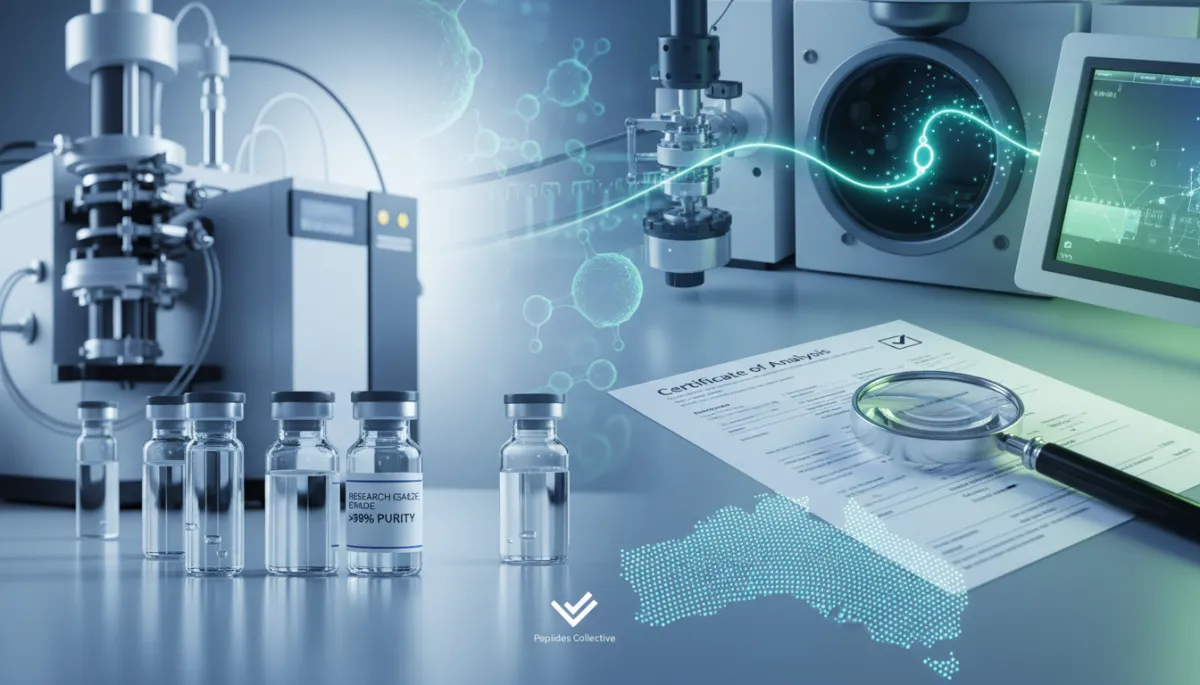
For Australian researchers and health professionals, peptide purity is not a technical afterthought – it is central to reproducible, defensible data. This guide explains how Peptides Collective in Perth, WA approaches peptide purity testing, what “research grade” (≥98% purity) really means, and how to interpret a peptide certificate of analysis (COA) with confidence.
What Is Peptide Purity – And Why It Matters for Australian Research
Peptide purity describes how much of the material in a vial is your intended peptide, compared with related by-products, truncated sequences, residual reagents, and other impurities. In practice, purity is usually reported as a percentage from HPLC peptide testing, where the main peak area is compared to all other peaks in the chromatogram (peptidepedia.org).
For in vitro assays, cell culture work, or preclinical models, low-purity material introduces unknown variables. Impurities may bind to receptors, alter signalling pathways, or confound dose–response curves. Even when impurities are “inert”, they dilute the active peptide, making dose calculations less accurate and cross-study comparisons difficult. This is why reputable Australian suppliers now treat robust peptide purity testing as a non-negotiable part of quality control.
HPLC Peptide Testing Explained Step by Step
High-performance liquid chromatography (HPLC) remains the gold standard for assessing peptide purity, particularly reversed-phase HPLC (RP‑HPLC) with UV detection at 214–220 nm (peptidepedia.org). At Peptides Collective, a typical HPLC workflow for purity looks like this:
Sample preparation – A small amount of the lyophilised peptide is accurately weighed and dissolved in a suitable solvent (often water with a small percentage of acetonitrile or methanol, plus an acid modifier such as TFA or formic acid).
Injection onto the HPLC column – The sample is injected onto a reversed-phase column (commonly C18), where peptides interact with the hydrophobic stationary phase.
Gradient elution – A programmed gradient of aqueous buffer and organic solvent separates the main peptide from impurities based on hydrophobicity. More hydrophobic species elute later in the run.
UV detection – As each component elutes, it passes a UV detector. Peptide bonds absorb strongly around 214 nm, creating a series of peaks on the chromatogram.
Chromatogram analysis – The main peak corresponding to the target peptide is identified by its retention time. Software integrates the area under all peaks and calculates purity as: (area of main peak ÷ total peak area) × 100.
Reporting – The resulting percentage (for example, 98.7% by HPLC) is reported on the peptide COA, along with method parameters and a copy of the chromatogram where possible.
📌 Key Takeaway: HPLC purity describes the proportion of UV-absorbing species that are your target peptide. It does not, on its own, confirm identity or account for non-UV-active components such as water or residual salts.
Mass Spectrometry: Confirming Peptide Identity, Not Just Purity
Because HPLC alone cannot prove that the main peak is the correct molecule, Peptides Collective pairs HPLC peptide testing with mass spectrometry (MS). Techniques such as LC‑MS, ESI‑MS or MALDI‑TOF provide an accurate molecular weight for the peptide, which is then compared with the theoretical mass calculated from the sequence (peptidepedia.org).
Modern high-resolution instruments can achieve mass accuracy within ±5 ppm, allowing confident discrimination between the intended peptide and closely related impurities or sequence errors. MS can also reveal post-synthetic modifications, adducts, or unexpected truncations that may not be obvious from HPLC alone. In other words, HPLC tells you how much of the material is one dominant species; MS tells you what that species actually is.
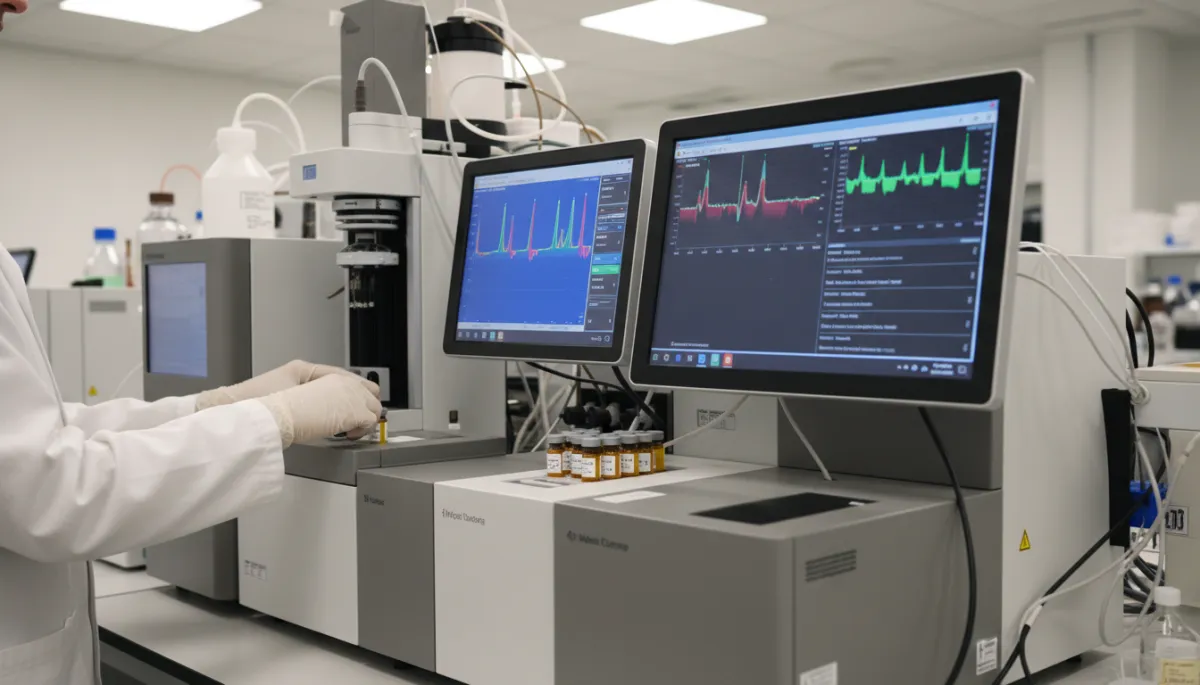
Combining HPLC and mass spectrometry offers both purity quantification and molecular identity confirmation.
What “Research Grade” Means: Minimum 98% Purity at Peptides Collective
There is no single global legal definition of “research grade peptides”. However, across leading Australian suppliers, the expectation is high HPLC purity, identity confirmation by MS, and batch-specific documentation (auspeptidewarehouse.com.au). Some providers advertise ≥99% as an aspirational benchmark, and pharmaceutical-grade materials often exceed 99.5% (preprints.org).
At Peptides Collective, “research grade” means a minimum of 98% purity by HPLC, confirmed by mass spectrometry. Lots that do not meet this threshold are not released as research-grade material. This standard reflects a balance between analytical rigour, cost-effectiveness for Australian laboratories, and the practical needs of in vitro and preclinical research where reproducibility is paramount.
💡 Pro Tip: When comparing suppliers, look for clearly stated purity thresholds and whether “research grade” is backed by HPLC and MS data, not marketing language alone.
How to Read a Peptide COA Purity Result: A Practical Checklist
A peptide certificate of analysis (COA) should give you enough information to assess whether a batch is suitable for your specific application. When you receive a COA from Peptides Collective or any other supplier, use the following checklist:
1. Product and batch identification – Is the peptide name, sequence, batch/lot number, and manufacture date clearly stated?
2. HPLC purity percentage – Is purity reported as “HPLC purity” with a numerical value (e.g., 98.4%)? Are method details (column type, gradient, detection wavelength) included or available on request (peptidepedia.org)?
3. Chromatogram – Does the COA provide a chromatogram or reference to one? Excessive peak broadening or multiple major peaks may warrant caution.
4. Mass spectrometry data – Are the observed and theoretical molecular weights listed? Is the match within the expected tolerance (often ±5 ppm for high-resolution MS) (peptidepedia.org)?
5. Additional quality metrics – For sensitive applications, look for water content (Karl Fischer), counter-ion analysis, residual solvents, and where relevant, endotoxin and sterility results (peptidepedia.org).
6. Laboratory accreditation – Has testing been carried out in an ISO/IEC 17025 or NATA-accredited facility, or to equivalent standards? Independent, accredited labs add confidence (pepmax.bio).
7. Red flags – Be wary of COAs that are undated, lack batch numbers, round all purity values to exactly 99.0%, or omit analytical methods (auspeptidewarehouse.com.au).
📌 COA Snapshot: For most Australian labs, a robust COA will show HPLC purity ≥98%, matching MS identity, and clear batch traceability. Anything less should prompt further questions.
Why Low-Purity Peptides Are a Problem for Research
Low-purity material may seem attractive from a budget perspective, but it often costs more in the long run. Studies reviewing online peptide suppliers have found that nearly half of tested products failed at least one quality metric when independently analysed (peptidegrades.com).
Unreliable dosing – If 10–20% of the vial is impurities, the actual amount of active peptide is lower than assumed, skewing dose–response relationships and making replication difficult.
Off-target effects – Related sequences or synthesis by-products may interact with biological systems in unpredictable ways, particularly in cell culture or in vivo models.
Data integrity risks – When impurities differ between batches or suppliers, reproducibility suffers. This can undermine publications, grant applications, or regulatory submissions.
Safety considerations – For animal work or ex vivo tissues, contaminants such as residual solvents or endotoxins can introduce confounding toxicity or inflammatory responses (peptidepedia.org).
By insisting on well-characterised, high-purity material, Australian researchers reduce avoidable variability and increase confidence that observed effects arise from the peptide of interest, not from uncharacterised contaminants.
Peptide Storage Tips to Help Maintain Purity and Stability
Even the best-characterised peptide can degrade if handled or stored poorly. To preserve the purity and stability of research grade peptides from Peptides Collective, consider the following practical guidelines:
Store lyophilised peptides frozen – Keep unopened vials at −20 °C or below in a dry environment. Avoid frost-free freezers that cycle temperature frequently.
Minimise freeze–thaw cycles – For solutions, prepare aliquots in sterile vials or microtubes so each aliquot is thawed only once before use.
Use appropriate solvents – Follow supplier recommendations for reconstitution. Some sequences dissolve best in a small amount of organic solvent (e.g., DMSO or acetonitrile) before dilution into aqueous buffer.
Protect from light and air – Store light-sensitive peptides in amber vials and limit exposure to air where oxidation is a concern. Flush with inert gas if necessary for highly labile sequences.
Label thoroughly – Record peptide name, batch number, concentration, solvent, and date of reconstitution on each aliquot. This supports traceability and helps align with institutional quality systems.
💡 Storage Reminder: When in doubt, consult the COA and product documentation. Stability data and recommended storage conditions are part of responsible peptide quality management.
FAQ: Peptide Purity Testing with Peptides Collective (Perth, WA)
Do I really need ≥98% purity for every application?
For exploratory in vitro work, marginally lower purity may still yield usable data, but it introduces more uncertainty. Peptides Collective sets a minimum of 98% HPLC purity for research grade peptides to support reproducibility across Australian laboratories and to align with emerging best-practice expectations (compoundreview.org).
Is HPLC purity the same as actual peptide content by weight?
No. HPLC purity measures the proportion of UV-absorbing species that are the target peptide. Water, counter-ions, and non-UV-active impurities are not reflected in this percentage. In some cases, a peptide that is 98% pure by HPLC may contain only 70–80% actual peptide by mass (compoundreview.org). This is why comprehensive COAs may also report water content and other compositional data.
Are Peptides Collective products regulated by the TGA?
Peptides supplied strictly for in vitro or preclinical research and clearly labelled “research use only – not for human consumption” fall outside the Therapeutic Goods Administration’s framework for therapeutic goods, provided they are not advertised or supplied for clinical use (ozpeps.is). This regulatory position allows Australian researchers to access high-quality reagents while maintaining compliance, as long as they are used strictly for research.
Can I request additional testing for critical projects?
For high-stakes or in vivo work, many groups now seek orthogonal testing such as endotoxin/sterility assays, amino acid analysis, or additional LC‑MS characterisation (peptidepedia.org). Peptides Collective can work with accredited partner laboratories in Australia to facilitate expanded testing panels where required.
How can I compare COAs from different peptide suppliers?
Focus on transparency and completeness. Look for clearly specified HPLC methods, chromatograms, MS identity confirmation, batch numbers, dates, and – ideally – testing in ISO or NATA-accredited labs. Community experience and independent reviews consistently highlight that incomplete COAs and vague purity claims are major red flags (reddit.com).
SEO Metadata (Status: PUBLISHED)
Meta Title: Peptide Purity Testing in Australia | Research Grade Peptides from Peptides Collective Perth
Meta Description: Learn how Peptides Collective in Perth, WA performs peptide purity testing using HPLC and mass spectrometry. Understand research grade (≥98% purity), how to read a peptide COA, and best-practice storage tips for Australian researchers and health professionals.
Focus Keyword: peptide purity testing
Research Use Only Disclaimer
All peptides supplied by Peptides Collective are intended strictly for laboratory research use only and are not therapeutic goods under Australian law. They are not designed, manufactured, or approved for human or veterinary administration, diagnostic procedures, or any form of therapeutic application. Nothing in this article should be interpreted as medical, veterinary, or therapeutic advice. Researchers and health professionals are responsible for ensuring that their use of research-grade peptides complies with all applicable institutional policies, ethics approvals, and Australian regulations.